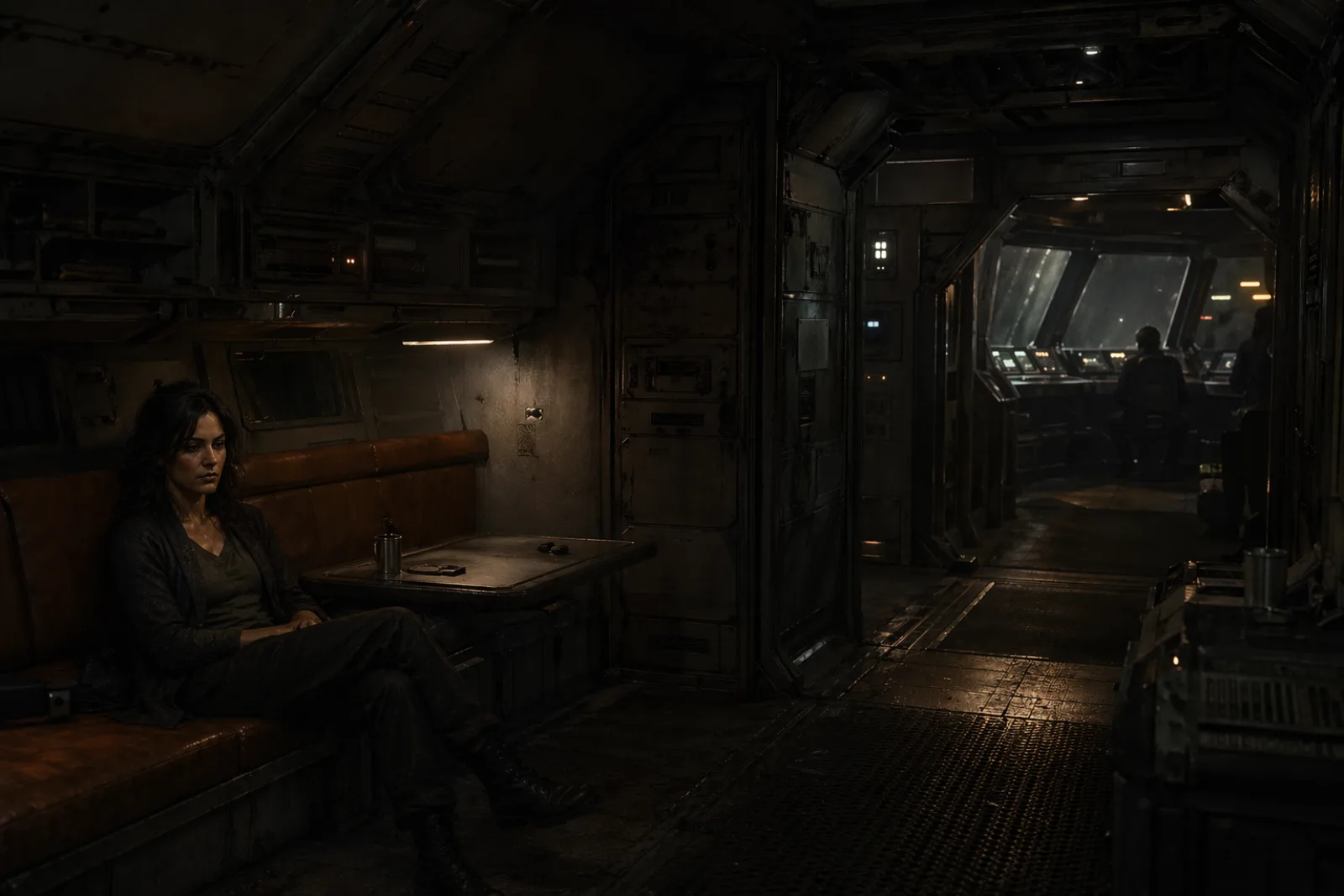
Captain Kaid Sidorov stood on the bridge of the CSS Rebel Ascendant with the decrypted packet burning on the command glass.
"Clonmel," he said. "Archer wants us off the old route."
That pulled eyes up around the bridge. A voice from the rear answered first. "What, you don't want to spend a week in Earth's newest playpen for managed decline?"
Kaid ignored that. "Says the window's now."
Nadira, small and sharp behind the glow of her station, glanced up. "Looks like we still need the Zephyr package after all."
Nadira had the disguise case up on the console before anybody else started moving. Nobody commented on that either. Alex always staged the ugly work within her reach, and she always pretended not to notice.
New coordinates rolled through the helm. The Ascendant answered with the familiar flicker through the deck as navigation shifted under Unity, a brief change in pressure and alignment that Kaid felt more than saw. Expected. Clean. The ship taking a new hand on the wheel.
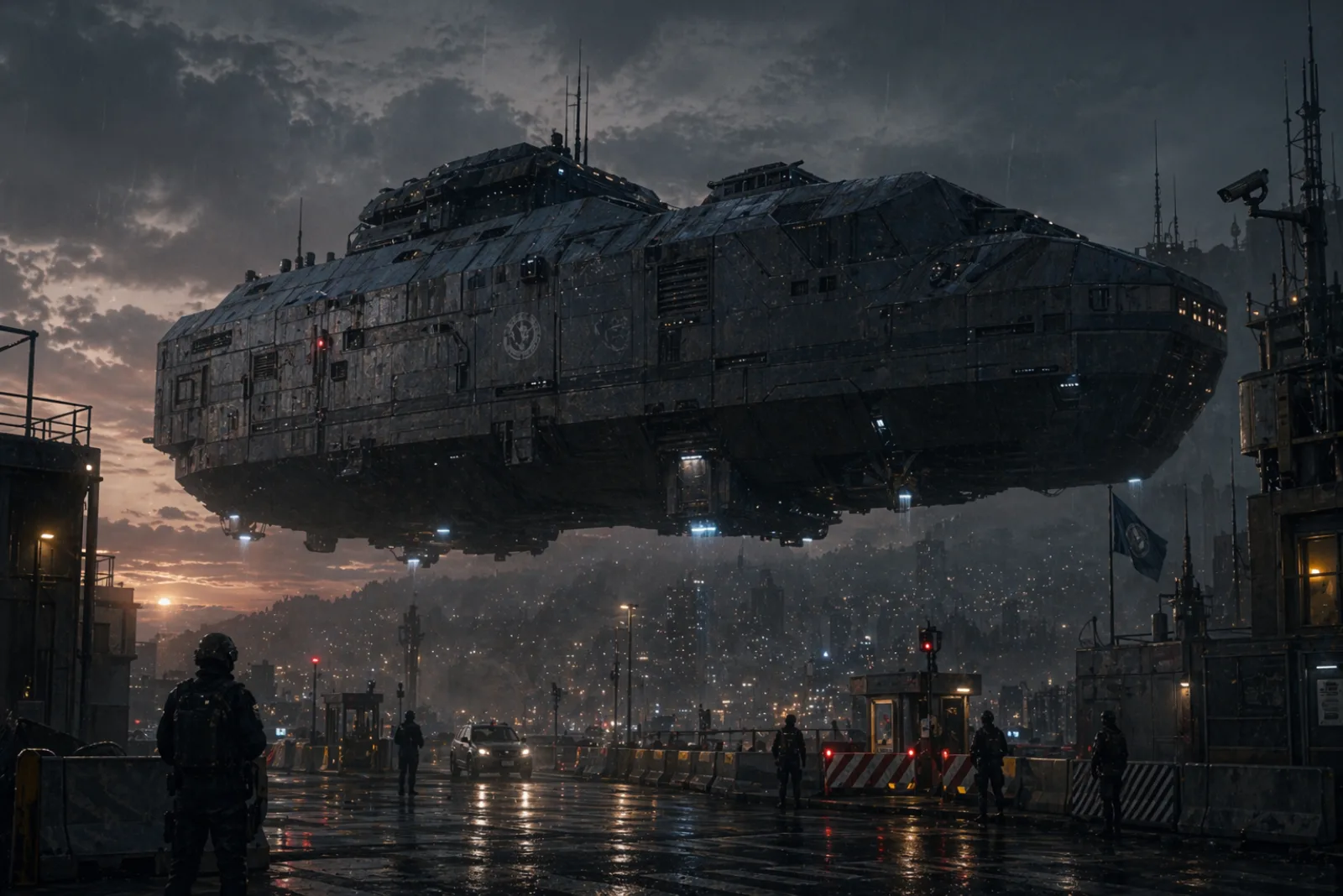
The Rebel Ascendant had always been built to lie for a living. At Zephyr they had pushed that talent further. From a distance she now read as a cheap NGO corvette transport, her paint peeled by reentry, her weapon ports buried under battered skin. Inside, the lie held too: dimmed lighting, scarred panels, interfaces made to look secondhand and overworked. She was forgettable, overused, and easier to wave past than inspect.
Kaid left the message up a moment longer. Archer had not used the buoy tree, the usual relay chain. He had burned a high-speed courier drone to catch the Ascendant between assignments, fast enough to intercept them before their next assignment was fixed. Even encrypted, traffic that moved that way stood out.
That was what bothered him. The precision of the interruption.
"They moved on the planet this week," he said. "We get in before the new systems settle."
"So they're still playing catch-up? Good," Nadira said.
Nadira applied a sheen polymer mask to her own face. "Expect some itching."
Kaid watched the disguise crawl over her features. Her cheekbones softened. Her jaw rounded.
Nobu watched his own altered reflection in a dark panel and bared his teeth at it. "If their intake stack's settled already, the cover story won't even get a turn."
"You say that like notoriety isn't flattering," Pepper said.
"It would be if the file photo were better."
Nadira cracked a smile.
"Easy drop, guys. Come on," Goblin muttered from his long runner's slouch near the rear, and Nobu barked a laugh.
Pepper's humor always thinned in the minute before things got stupid. Kaid had learned to trust that as much as any briefing.
Pepper stood a little apart from the joking, one big hand resting near the silver cross that normally hung at his throat. His thumb rubbed once across the metal before he tucked it beneath his shirt and let the chain disappear under the collar. "If this turns into questions, I'll handle it."
The prep cycle finished. Nadira checked the final readouts. Alex's voice came over comms from deeper in the ship as he pushed the synthetic DNA overlay through the relay chain and into each of their temporary identities.
"Genome mask is live. If somebody samples you, give me half a second and don't panic."
"That your formal engineering guidance?" Nadira asked.
"That's the gentle version."
Kaid heard the exchange and, beneath it, the older rhythm under the words: Nadira prodding, Alex pretending irritation, both of them already halfway through the same calculation.
The Rebel Ascendant dropped through Clonmel's atmosphere and settled at the main processing hub of Fidelis with a muted, unremarkable thud. As the cargo port yawned open, security lights washed the landing pad in white glare and vapor poured off nearby shuttles. Patrol teams in local armor moved people through the starport like insects, datapads flashing while drones skimmed overhead and voices echoed between scaffolds and temporary barriers.
They had arrived as part of an asylum caravan. Ugly, crowded, and easy to vanish inside.
Alex stayed aboard, throwing them a brief gesture to confirm comms before fading back into the ship's interior.
The team moved with the refugee flow.
Initial registration passed without friction. Their counterfeit identities held. The first tent line spat them out into the wider transport commons, where new arrivals jostled with locals. It was easy to see who came for Federation promises and who was trying to buy their way off-world before a new reality hardened around them.
"Still dirty," Kaid said.
"No," Alex murmured over the channel, taking in something else altogether. "Used to come here with my folks. Those native trees have roots dozens of meters deep. Whole little worlds under them. They're tearing all of it out."
Kaid looked past the crowd at the line of forest beyond the built edge of the city, then at the fresh cuts, the scaffolded feed lines, the machinery chewing at ancient green things.
"Focus, Alex."
"Right." The channel stayed open long enough for Kaid to hear Alex pull one breath carefully through his nose. Then the soft background hiss vanished. Alex had muted himself.
Ahead, the last checkpoint narrowed the crowd into a single controlled throat: mobile scanners, armed officers, too much light, too much waiting.
"Real smooth handoff," Nobu muttered.
A drone dipped low over the line and its rotor wash tugged at their ponchos. Some of the refugees flinched away from it, opening a pocket of empty space around Kaid's team. The drone paused in the sudden gap that had made them visible.
Kaid felt sweat run once, cold and straight, down his back.
Nobu moved first. He rammed his shoulder into a nearby civilian with just enough force to start an argument three bodies wide. The drone slid toward the disturbance.
"Sorry, first time seeking asylum," Nobu said to no one who believed him.
Then Goblin stiffened, his hand snapping to his throat. "Mask lattice is glitching," he whispered, and his voice lurched with it. His borrowed face began to crawl out of calibration.
"Stall it," Kaid said. "We can't stop here."
Goblin caught himself on Kaid's shoulder and folded inward with ugly, convincing misery. "Can't breathe," he rasped.
"Medical condition," Kaid said to the nearest watcher, already guiding Goblin forward. "Asthma. Head meds too."
People recoiled and let them through with muttered irritation and visible distaste. It got them to the checkpoint officer.
"Documentation."
Pepper stepped between the officer and the rest of the crew, broad enough to change the conversation simply from his size. He touched where his cross sat under the fabric of his shirt, then slipped into the voice of someone who had spent too long arguing with minor authorities for a living.
"Officer, I assure you we're in full compliance. If this needs to be noted as a medical accommodation before processing, we'd be grateful."
The officer checked Pepper, Goblin, then Pepper again, his eyes narrowing faintly.
"He's having trouble breathing. If you need to flag it, flag it. We'd just rather not do this in the middle of your line."
Behind Pepper, Nobu worked at Goblin's collar and neck seal.
Goblin's face spasmed. His vocal cords broke through a series of noises so grotesque the officer's entire attention narrowed to him.
"Submit for a genetic read," the officer said at last.
Goblin extended his arm and the Fed reader bit into the sample.
The screen cycled once. Twice.
The officer checked the reader, Goblin, then Kaid. This time his eyes stayed on Kaid.
Kaid saw the break and ran it forward: first shot center mass, flechettes opening through the officer's chest before the man could finish turning his head. Then the tech behind the partition, if there was one. Then the line breaking wide on fear and disgust while the drones corrected and the port hardened around them. Goblin shoved forward, Pepper behind him, Nadira moving only when he said move. Kaid stepping the wrong way on purpose, showing the shooters where the problem was so the others could vanish into the first cover they found.
If it broke here, he was probably staying behind. He held the officer's gaze and gave him nothing.
The reader kicked back a yellow-band result:
PROVISIONAL MATCH
MEDICAL EXCEPTION
INTAKE REVIEW DEFERRED
The officer's mouth tightened.
Pepper saw it too. "That's what I was trying to tell you."
"You said asylum?" he asked.
"That's right," Kaid said.
The officer's gaze stayed on him a moment longer, flat and administrative in a way that felt worse than hostility. Then his eyes dropped back to the reader.
"Clear," the officer grunted. "Report to medical once you're settled."
Goblin gave him an apologetic nod so elaborate it nearly tipped into mockery.
The officer caught Nadira's wrist as she moved to follow.
"You too."
For one instant, Kaid felt the operation slide sideways.
Nadira gave him a baffled little smile that bordered on insult. "Officer, if I've got what he has, I'd rather die surprised."
The officer let her go with visible distaste and waved them by.
Kaid's hand was still wrapped around the weapon beneath his poncho. Nadira walked past him, alive and annoyed. He made himself let go and followed.
They kept walking. Only after the checkpoint fell behind them did Alex speak.
"Malware payload rode the genome read," Alex said. "Injected through the sample, spoofed the result. Didn't give us clearance. Just a medical exception and deferred review. Didn't think it'd hold that long. Thought he'd keep looking longer."
Nadira rolled her eyes at that. "Three military-age men and one tired xola," she said, using the old Uzbek family word like a private joke, "and he still let the machine do the thinking."
"Clonmel doesn't matter to them," Nobu said. "It's the asset."
Nobody said anything for several steps. Goblin was still breathing hard. Nadira flexed the wrist the officer had caught once, as if annoyed her body had remembered it. Then Alex started talking in their ears again.
Kaid let the crowd carry them another block before he angled them off the main drag and into a side alley. Shadows, damp concrete, surveillance still thick overhead.
"New plan. Subterranean utilities access. Two blocks from the meet."
"Those tunnels should be crawling with maintenance drones," Nadira said.
"Better than patrols up here."
They moved.